
Trout Creek Fuels Reduction & Meadow Restoration
Why is Restoration Needed in the Trout Creek Meadow?
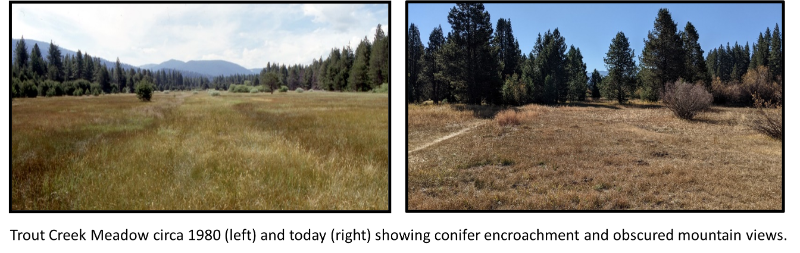
- The meadow is transitioning into a forest and we are losing ecosystem resilience while
increasing wildfire risk for the surrounding community.
- We lose an acre of meadow habitat every year to lodgepole pine encroachment. LTCC has lost over 40 acres of meadow since 1980.
- Meadow trees prematurely dry out the meadow, and densely spaced trees with low-lying limbs contribute to increased wildfire risk.
- Lodgepole pines outcompete other native plants for water, sunlight, and nutrients, leading to rapid declines in biodiversity and habitat complexity, making the environment less resilient to drought, disease, and other environmental stressors.
- Over 75% of the meadow and stream environment zones in the Lake Tahoe basin have been
lost or severely degraded.
- These environments are important because they contain 85% of the basin’s species.
- Meadows perform a number of critical watershed functions that influence water quality and quantity.
- Meadow systems function as natural filters that help to maintain lake clarity.
Background
The meadow and stream behind the college is known as Mutushahoo Watah (whitefish waters) by the Wá·šiw — the Washesu People. The Washoe inhabited the site where the college now sits since time immemorial. They migrated seasonally, with many living in the Carson Valley during the winter and moving up to Tahoe for the summer, where they would hunt, fish, and gather food and medicinal plants growing in the meadow behind the college. The Washoe would also use fire as a tool to maintain the meadow ecosystem and to support the growth of culturally significant species. The Washoe encampment at Lake Tahoe Community College (LTCC) was used up until the 1950’s.
Modern land management practices and the lack of regular fire within the watershed have allowed lodgepole pine to encroach into the Trout Creek Meadow. Trees outcompete native meadow plants for sunlight, water, and nutrients. As a result, the meadow behind the college has been slowly transitioning into a forest. Meadows support more than 85% of the biodiversity in the Tahoe Basin, and they provide a variety of watershed services that help maintain lake clarity. That is why LTCC is partnering with the Wildlife Conservation Board, the Tahoe Resource Conservation District, and the Washoe Tribe to restore 30 acres of the Trout Creek Meadow on LTCC property.
Project Specifics
A grant from the Wildlife Conservation Board provides LTCC with the support it needs to restore the meadow. The Trout Creek Fuels Reduction and Meadow Restoration Project will reduce wildfire risk for the surrounding community by removing encroaching conifer across ~30 acres of historic meadow. The college is also engaging with South Lake Tahoe’s Fire Protection Division partners to explore the use of prescribed fire and traditional ecologic knowledge held by the land’s first stewards, the Washoe Tribe, to help increase the diversity of native plants and culturally significant species once found in the area. The project will restore native plants, habitat & culturally significant species, provide ongoing educational opportunities, reconnect Indigenous Communities with the landscape, and enhance the meadow’s resilience to drought, fire, and future environmental stressors.
Partners

Restoration Goals
- Ecosystem Restoration: Restoration will include removal of encroaching lodgepole pine from approximately 30 acres of the meadow surface. This will help restore lost meadow habitat, improve biodiversity, reduce wildfire risk, sustain local groundwater and stream flow, and enhance the meadow’s resilience to drought, disease, and other environmental stressors.
- Reconnecting Indigenous Communities with the Landscape: Restoration may also incorporate traditional knowledge and cultural burning practices. Prior to 1900, the Washoe people used fire as a tool to maintain the meadow ecosystem and support the growth of culturally significant species. Partner agencies are currently exploring the feasibility of conducting low-intensity understory burns on the meadow surface (up to 2 acres per year) as part of a collaborative study that may also include the propagation and planting of native species following burn activities.
- Education: Through community partnerships and student-led work, the college hopes to monitor and analyze the effectiveness of strategies to inform future restoration practices in the Tahoe area. The college will also install several educational signs along the meadow trail network to inform the public about restoration techniques, cultural practices, and the importance of self-sustaining ecosystems.
- Future Collaboration: Watershed restoration along Trout Creek may also include working with the California Tahoe Conservancy to install fish habitat structures. Natural materials may be used in the stream channel as part of a collaborative study to enhance fish habitat and curtail stream erosion.
Answers to Common Questions
- Isn’t deforestation bad? — It depends. In this case, this area was never a forest. The trees we see today grew as a response to human disturbance and land management. Deforesting a meadow to restore this important ecosystem is an appropriate strategy to address historical mismanagement.
- Which trees will be removed? — Ideally, there wouldn't be any trees growing in the meadow. Almost 100% of the trees growing in the meadow are lodgepole pine, and nearly all of them are less than 50 years old. Resource specialists and registered professional foresters have recommended removing all of trees from the meadow surface. What constitutes the meadow surface, you ask? The flat ground adjacent to Trout Creek that is struggling to grow grass and forbs under a canopy of trees would generally constitute the meadow surface. Trees growing on a slope with an understory of sage or bitterbrush would be considered upland forest and will remain undisturbed. Refer to the map below to see the areas that have been proposed for restoration.

- What will happen to all the trees once they are cut? — The Washoe Tribe has been gifted all of the trees that are harvested from the property. Lodgepole is turned into cordwood and used in the Tribe’s firewood program to warm elders' homes.
- How can fire management strategies be used to restore the meadow? — Many meadow plant species depend on disturbances like floods and fire to germinate. Seeds can lie dormant in the soil for over 75 years. LTCC is working with the local Fire Protection District, and, if local regulations allow, this project aims to study the post-fire response of meadow grasses and forbs. Burning would occur on small, football field-sized plots for one day each fall. Since all woody material is to be removed from the meadow, only meadow grasses would be burned. No smoldering piles or prolonged smoke.
- How is cultural fire different than prescribed fire? — Cultural fire and prescribed fire are both methods of intentionally applying low-intensity fire to the land to reduce hazardous fuels and restore ecosystems, but they differ fundamentally in their goals and methods. Native tribes will use fire to manage the landscape to cultivate culturally significant species. A cultural fire in this meadow would be small, short lived, and used to encourage the germination of native species.
- How will the wildlife and current ecosystem be affected? — Some disturbance is inevitable. All project work will be conducted after nesting and migratory bird season. Forest species will migrate to drier upland forest environments as meadow plants expand their range and the ecosystem stabilizes.
- Will the college get a lake view if they remove meadow trees? — That sounds nice, but no. Geometry and geography are not in our favor.
- Will I get a better view of the meadow from my house? — Maybe. Some homes in the Sierra Tract neighborhood back up to the Trout Creek Meadow, but a majority of the meadow on that side of the creek is owned by the California Tahoe Conservancy. Tree removal will only occur on college property.
- How do I submit a comment? — Email meadow@ltcc.edu with questions and comments about this project.
Restoration Timeline
- 2013 — LTCC identifies hazardous fuels accumulation and recognizes an ecologic change in the meadow composition. The California Conservation Corps is contracted for forest thinning and fuels reduction work in the Trout Creek Meadow.
- 2022 — LTCC engages with the Washoe Tribe about using traditional land management practices to restore meadow biodiversity.
- 2025 — LTCC acquires CEQA, TRPA, and Lahontan Water Quality Control Board permits to conduct meadow restoration.
- 2026
- February: The Wildlife Conservation Board awards LTCC grant funds to pursue meadow restoration.
- April: The LTCC Board approves using the Tahoe Resource Conservation District for contract management.
- July: Public meetings held at LTCC to discuss restoration activities and receive public comment. Public comments may influence future timeline. Read notes from public meeting.
- August: Development of timber contract.
- September: Proposed timber operations.
- 2027 — Site rehabilitation, proposed cultural burning activities, and native planting.
- 2028 — Trail work, educational signage installation, and vegetation monitoring.
Da?aw?aga?a (Tahoe) is not a “thing” to be saved, but a relative to be in relationship with. Stewardship means listening to the land, to the water, and to those who have known it the longest.